
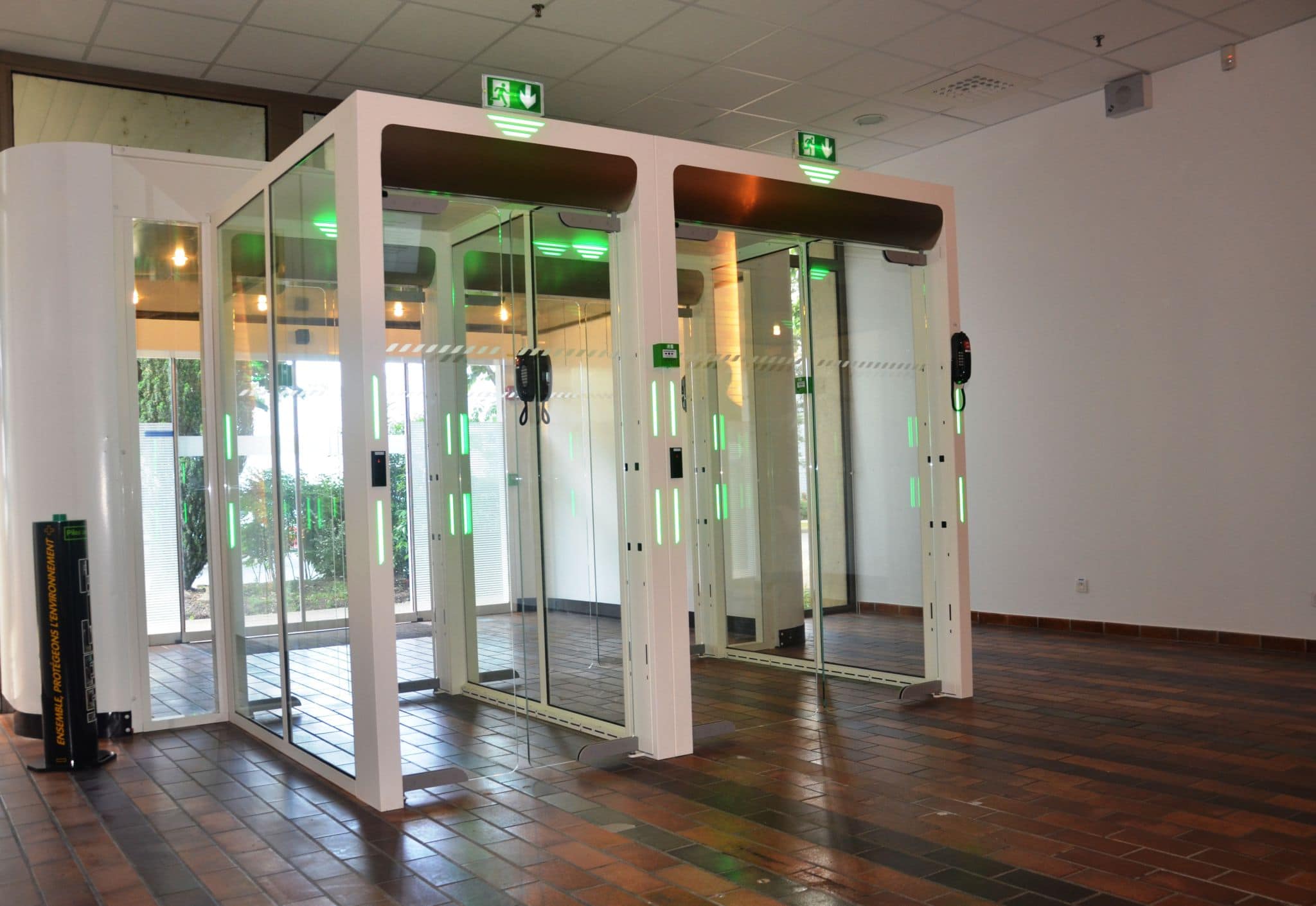
The security of sensitive sites is governed by a number of international standards. In recent years, these international regulations on the protection of sensitive sites have been tightened. They are subject to new requirements in terms of the prevention of malicious risks. These risks are of various kinds: industrial secrecy, terrorist attacks, organised crime, etc.
Mainly integrated into a complete protection system, the security airlock provides better control of entry and exit flows by regulating pedestrian access to a secure site. Find out how a security gate can be integrated into your site and raise its level of protection.
SAFETY LOCKS: ADAPTING THE SAFETY SYSTEM TO YOUR ENVIRONMENT
Although airlocks are an essential part of a protection system for a sensitive site, they are often perceived as a constraint. However, if it is well thought out, a protection system incorporating security locks in no way hinders user activity. On the contrary, it inspires confidence in users.
To achieve this, it is essential to analyse flows and usage before designing and installing the security system. This observation phase enables us to design an airlock that fits in perfectly with the site’s environment:
- entrance control that takes account of the different types of passageway (logistics passageway, fire service access, pedestrians, people with reduced mobility, etc.),
- a mechanical design that corresponds to the desired level of security (burglar-proof or bullet-proof),
- an aesthetic finish that blends harmoniously and discreetly into the environment.
SAFETY INTERLOCK: 3 PROTECTION PARAMETERS
The safety level of an airlock depends on 3 additional parameters:
- mechanical protection
- electronic protection
- a servo mechanism
Mechanical protection of an airlock
The mechanical protection consists of 2 successive levels of doors. The major advantage of this arrangement is that the two doors are never opened simultaneously. This makes it impossible for documents to circulate between two people on either side of the security gate. As a result, this succession of two doors creates a real boundary between the public area and the secure area.
The two-door layout offers a degree of flexibility in terms of compliance with the deconstruction standards applicable to the sensitive site’s area of activity. Safety requirements can be taken into account on one of the two doors:
- fire-retardant or flame-retardant performance
- burglar-resistant or bullet-resistant performance EN 1627, EN 1522, EN 1063
- cages de faraday
Electronic protection of a security gate
Electronic protection is also achieved by adding electromechanical locking and/or detection devices:
- presence detectors
- electromagnetic suction pads
- single passage detectors
- motorised locks
- weight or position detectors
The combination of these techniques contributes :
- tighter controls on user transit
- that the doors are properly locked
The space between the two dock shelter doors means there are many possible combinations. So, depending on your security needs and your budget, your security solutions provider can offer you the most suitable combination for your sensitive site.
Automatic control of an airlock
The automatic control system is the most sensitive part of an access control system for a sensitive site, as it has a direct impact on how easy it is for the user to use the security entrance.
It also takes into account the different access strategies to sensitive premises: defence zones, archives, data centers and crisis units. During the study phase prior to the design of the security system, the following are carried out:
- a flow study
- a functional analysis describing the different modes of use
This preparatory phase also enables the design of a control system adapted to the various types of passage required, such as :
- for people with reduced mobility
- logistics gateway
- stand-alone operation or manual operation from a security PC
- fire brigade or security force access
SAFETY INTERLOCK: CHOOSING THE RIGHT PARTNER
The installation of a security airlock, if carried out correctly, can also raise the level of security at a sensitive site.
In order to design an airlock that functions perfectly in line with the customer’s needs, regular dialogue between the prime contractor for the safety solution and the airlock manufacturer is essential throughout the project.
In most cases, it is necessary to carry out a functional acceptance inspection of the safety interlock at the factory, before it is shipped to the sensitive site. This also enables the prime contractor to check that the safety lock complies with the customer’s expectations.